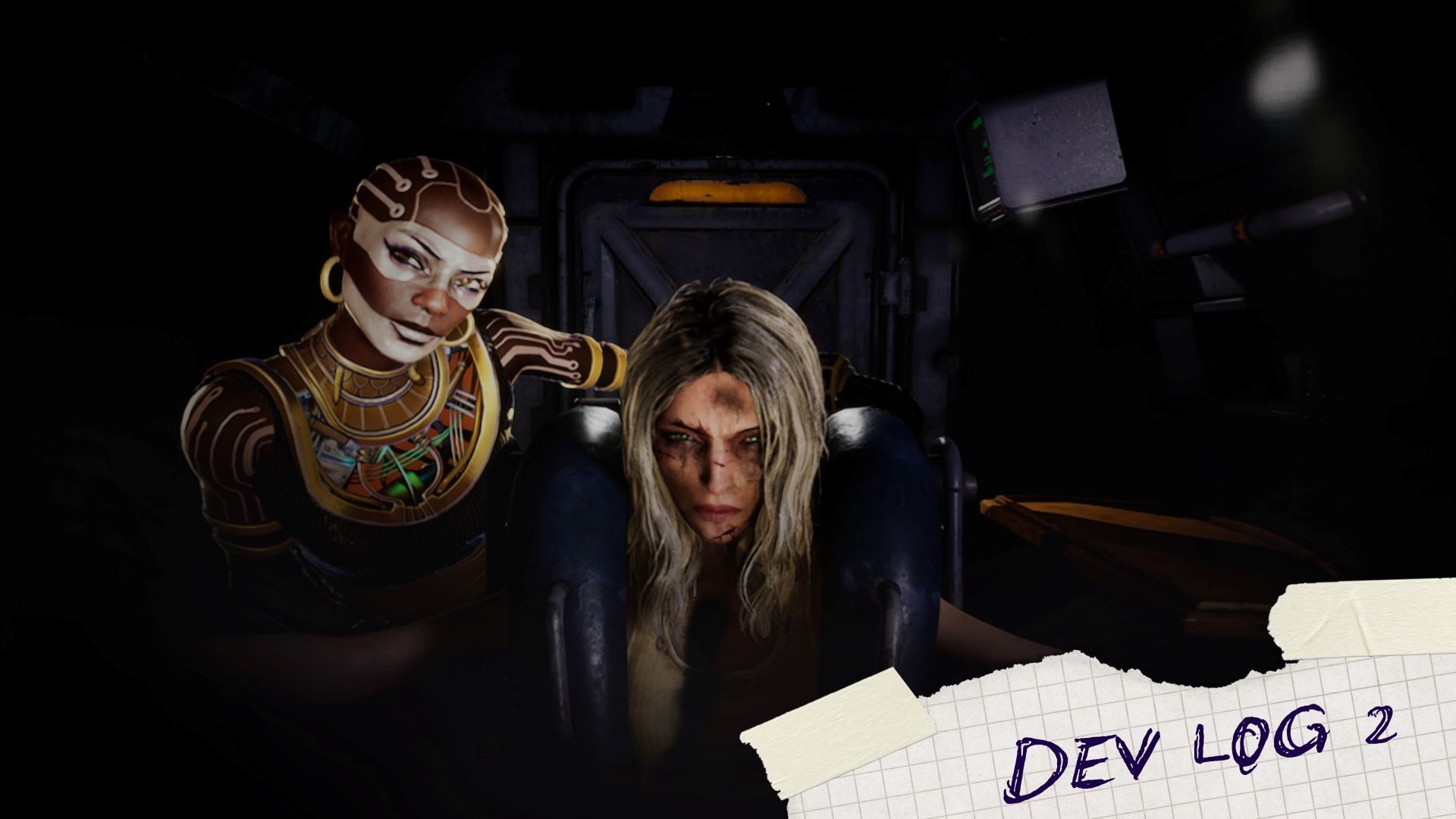
Hi everybody. It’s been a few months since our first dev log. We balance our time between working on the game and sharing our progress. Today, we want to give you a peek into the creative process of some of the key members of the development team that have shaped this game.
Creating “Judas Simulator”
People often think our games start with story, but we always start with core design elements. In BioShock, it’s the Big Daddy and Little Sister bond. In Infinite, it’s the side character, Elizabeth. In Jude, it is a dynamic narrative. We asked ourselves, “How do we tell a fully realized story so that characters can respond in real time to even the smallest choices the player makes?” Figuring out how to do that at a systems level took years. Eventually, the pieces build up around our main character, Judas.
“This project started with our desire to tell stories that were less linear, that reacted to the player and unfolded in ways that no one had ever seen in one of Ken’s games. That told us a lot at the start about what we needed: namely, characters with strong, competing goals, each of whom had a stake in everything the player did. Starting with that framework, we spent a lot of time thinking about those characters, their conflicts, the right setting to force them all together, and the systems underlying it all. For a long time, in there’s not even a protagonist — just a kind of cipher, a blank slate.
Eventually, the story and world start to coalesce into something specific, and we need to figure out who the player characters are. Typically, you want to place your heroes in the last place they expect to be found. So what kind of person really has a hard time dealing with all these conflicting relationships and interests? And I remember that’s when Ken came up with the monologue that started it all.”
– Drew Mitchell, Lead Narrative Designer
“I often get ideas while I’m running, and one day I thought of this speech that would define the character we’re trying to figure out. This speech popped into my head as I struggled through the third mile.
I only eat at vending machines, because I don’t like interacting with waiters. Restaurants are more complicated: there are greetings and “hello”s and “Is this table OK?” And I thought, “Why should I care about your recommendations? You’re not me!” But I wasn’t supposed to say that, so I just had to count the seconds until the interaction ended, thinking of socially acceptable ways to say, “Go fuck yourself.” Because for me, conversation is the beginning of failure. The vending machine never asked me a question I didn’t know the answer to. Exchange is reduced to transactions: money comes in, products go out. Why can’t people be like that?”
– Ken Levine, Studio President & Creative Director
Caption: Judas Concept Art
This stream of consciousness becomes a touchstone that we continue to use for the characters and ultimately the entire game. “Judas,” as he came to be known, understood machines in a way he could never understand humans. It became his greatest strength… and his greatest weakness. We put him in a science fiction world, a colony ship filled with robots — a futuristic setting that makes someone like him incredibly powerful. But this is also a world where personal success depends on how well you can stick to the rules, as disagreements will lead to mission failure. It made him a criminal, a pariah – a Judas. The tension at the heart of those characters emerged to inform everything about the game, which we stopped thinking of as an FPS and started calling it “Judas Simulator.” It all goes back to the core idea of you interacting with the world as Judas.
“I think the thing that most differentiates Judas from BioShock or BioShock Infinite is in the name. The game is named after him. Booker and Jack are strangers in a strange land, just like the player. Judas is a native of the Mayflower. In fact, he’s at the center of the events that set the story in motion. He’s got a history with this world and the people in it – most of it very, very bad. The story is about more than just getting off a sinking ship, and it gives the player so many ways to determine how his journey plays out.
There’s always a risk in giving players a very clear and vocal character to control. You are always worried about creating dissonance between them. So it was great to see the testers stop and ask themselves, “What would Judas do here? How would he react?” It shows that they are having a conversation with the character and taking him and his journey seriously.”
– Drew Mitchell, Lead Narrative Designer
May Flowers
We want to communicate this world as best we can, not just through knowledge, but visually. A unique challenge in creating our colony ship setting was that it was a much older space to create for player exploration. Rapture and Columbia have been around since their inception. But the Mayflower has been sailing for decades, and has changed a lot since its departure.
“At the start of its journey, it was a more practical, conventional, modular starship. But over the course of its mission, due to conflicts between societal factions and ideals, it changed into what you see today. And we sought to communicate this through the environment. As with any city with an important history, if you start digging through its streets, you will discover layers of the city’s past. Eras of streets long buried, forgotten, and rebuilt by the roads you walk on now. With the Mayflower as a generational starship, we wanted to imbuing this world with the same sense of time, history, and credibility; it’s a civilization that’s weathered an era of conflict and rebirth. And having the world’s characters and architecture reflect those layers of the onion is a powerful mechanism for visual storytelling.
This allows players to act as historians and architects as they explore the Mayflower. By uncovering more, you will make more informed decisions about the story and characters on your journey.”
– Nathan Phail-Liff, Studio Art Director
Another factor in creating this setting is the dynamic world itself, not just the story and characters. Just like dynamic narratives, we have to train the system on what makes a good environment by using sophisticated tagging and rules to populate the world with believable design elements.
“We basically identified the puzzle pieces and sets of content that we wanted to make into the Mayflower setting. One example was the living quarters. We didn’t just have one type of space – we had different categories: VIP Pilgrim Quarters, Regular Pilgrim Dorms, all the way up to Trespassing Quarters. The art team created the set pieces and materials for each of these venues and the design team did a deep dive into how all of those pieces could fit together in a variety of layouts that fit the needs of the theme and supporting gameplay. When putting together an in-game layout, the system had to understand the different sets of puzzle pieces and a hierarchy of content so that it can tie it together in a meaningful way that supports the storytelling. More exclusive and luxurious venues can have high ceilings, giant windows, and visually and physically large lobbies.”
– Karen Segars, Lead Artist
In our previous games, we would have done all this by hand, but that didn’t allow for the dynamism we were after. So, we took on this challenge to teach the system how to be a storyteller and interior decorator, creating a set of rules that we believe in so that the system can inhabit the world in a believable and engaging way that allows for reactivity in a way you’ve never seen in our games before.
Would you please?
We want to know what you’d like to read more about in future Dev Logs. So please, tell us on our social media or via email what interests you most about Judas and how we created it.
Teknologi Terkini
Agen Togel Terpercaya
Bandar Togel
Sabung Ayam Online
Berita Terkini
Artikel Terbaru
Berita Terbaru
Penerbangan
Berita Politik
Berita Politik
Software
Software Download
Download Aplikasi
Berita Terkini
News
Jasa PBN
Jasa Artikel
News
Breaking News
Berita


