Causal Loop has always been a dream project for us. Over the past four years, its growth has far exceeded our initial estimates. Once you start pulling out the threads that tie together a game’s story and its mechanics, you’ll quickly realize that you can’t just ignore certain ideas or dance around them. If a puzzle exists in the world, it needs an explanation.
The story and puzzles are designed together, not separately
Initially, we didn’t design the puzzles along with the story. During the prototyping phase, we sketch out mechanisms and figure out what works in multiple iterations of the same puzzle. But early on, we realized that we wanted to tell a more involved story, and to tell this story well, the gameplay had to complement each other.
We expanded on already designed puzzles, so they made sense within the story. The core mechanics remain the same, but the goal changes. It’s no longer just about opening a door or unlocking a gate. Now, you might be controlling a device that has a clear narrative function or looking for something that is directly related to what happened before.
Puzzles and story become inseparable, as story naturally begins to interact with gameplay in a way that ties the two together.
Just like the story itself, these puzzles are also intrinsically about choice and causality, your choices embedded in every action you take. These go hand in hand. Especially when you record your own echo, every movement becomes a deliberate decision.
Echo system and diegetic design
A great example of how integrated everything is is the echo system and the way we present it to the player.
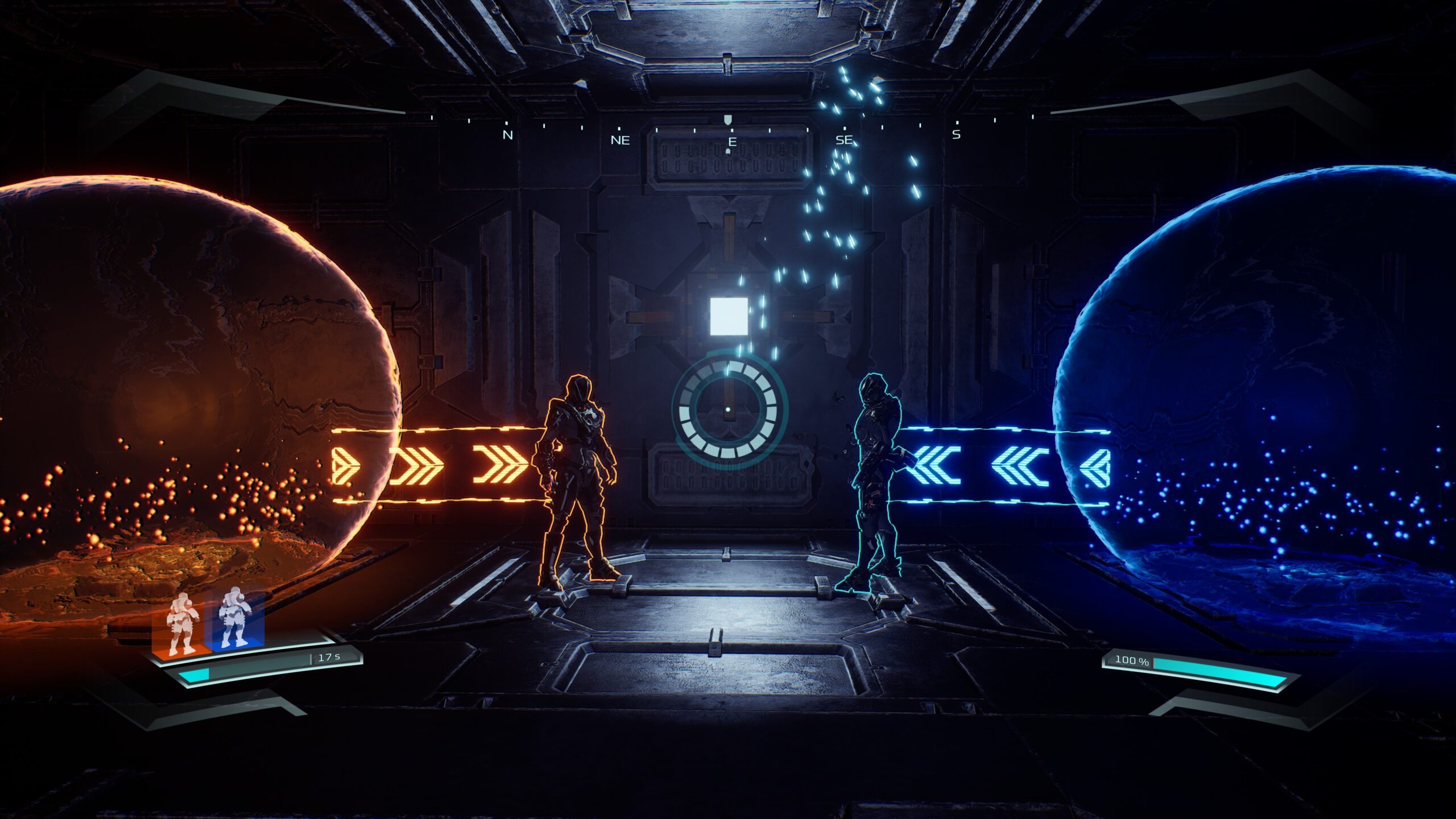
We use a diegetic interface, meaning everything you see as a player is also seen by the protagonist. So, when you create an echo for the first time, it doesn’t make sense for it to highlight or immediately display a path. Rather than just adding it as a gameplay element into our UI, we incorporated it into the story, with Bale having Walter implement a way to visualize it.
A common problem in puzzle games is a disconnect when the player asks: why is this here? Especially in environments that are supposed to feel real or functional. We took this into consideration throughout our development, to ensure there was a reason why this puzzle was on this planet. If players pay attention, they will understand why things happen and that the systems they interact with are part of something bigger.
To enhance the player experience, we also use lead-in and lead-out areas to control how the player moves through the experience. Before creating a puzzle, we often focus on the story. This is where we can introduce context, build tension, or convey important information. Then, once you get into the puzzles, the focus shifts to gameplay, which is framed by the bigger picture of the scene currently taking place in the story. This was a deliberate structure, and we constantly adjusted it depending on what was narratively necessary at the time.
World building occurs through interactive problem solving
The first version of how we told our story felt imprecise and had too much telling and not enough showing, with characters commenting on everything the player saw. It feels unnatural.
Rather than relying too heavily on character narrative, we relied more heavily on environmental storytelling and player discovery. The world itself gives you clues, such as collapsed buildings, old recordings, or remnants of past events. You are not told what exactly is happening, but you are putting it together yourself. In the end, we chose a mix of clear delivery, environmental storytelling, and dialogue. If any of these elements are missing, players risk misunderstanding key aspects of what is happening. Of course, attempts to eliminate this risk will lead to many repetitions.
A good example is a force field that only affects echoes. In previous versions, they looked like solid barriers, so players assumed they couldn’t get through them, but they could. So in many cases we had to adjust the presentation, to always make sure there was guidance or clarity, without explaining too much. And this is how we do not only puzzle design but also world building.
For example, we developed details like the Tor calendar system because we needed that context ourselves. If we attach a date to an object or record, the date must make cultural sense. It’s a common pitfall when writing: You realize you need more context, not for the player, but for yourself.
Only a small portion of that information makes it into the game, but in theory, players can reverse engineer it if they want.
Share creative vision across small development teams
I’m very interested in the existential side of science fiction. What does it mean when there are many versions of yourself? Are you still the original? What happened to your echo?
Daniel is much more focused on the gaming experience. He wanted the mechanics to feel clean and intuitive, without any story getting in the way or over-explaining things.
This is why Daniel focused on the logic of the puzzle, while I built the narrative logic around it: how you enter the puzzle, what it means in the story, and how you get out again. Then we take a step back and ask: does this make sense from both a gameplay and story perspective? It’s that balance that makes it work.
There were several instances where the story made us reconsider the design of a level. While in one chapter we had to change the overall layout of the level to fit the story progression and had to accommodate additional cutscenes, we had to redesign the puzzles to maintain the narrative tension of a scene without the player having to suddenly leave the area in another scene. In the second example, the puzzle itself went through four or five major iterations.
In addition to the game design and narrative naturally intertwining, players can also look forward to excellent game performance from a technical standpoint. Daniel and I not only learned a lot about the world we created together, and about working with each other in the process of creating Causal Loop, but also learned – and continue to learn – a lot about Unreal Engine 5. Our experience having been in the industry for almost 20 years, meant we were able to incorporate all that learning into our workflow quite smoothly.
It’s been amazing to see that people have engaged with Causal Loop and supported us along the way by playing demos and joining in with their thoughts and feedback. We hope players will enjoy this final version of the game with all its secrets, connections, and hidden layers that reward those who take the time to look deeper.
Causal Loop launches on PlayStation 5 on April 23.
PakarPBN
A Private Blog Network (PBN) is a collection of websites that are controlled by a single individual or organization and used primarily to build backlinks to a “money site” in order to influence its ranking in search engines such as Google. The core idea behind a PBN is based on the importance of backlinks in Google’s ranking algorithm. Since Google views backlinks as signals of authority and trust, some website owners attempt to artificially create these signals through a controlled network of sites.
In a typical PBN setup, the owner acquires expired or aged domains that already have existing authority, backlinks, and history. These domains are rebuilt with new content and hosted separately, often using different IP addresses, hosting providers, themes, and ownership details to make them appear unrelated. Within the content published on these sites, links are strategically placed that point to the main website the owner wants to rank higher. By doing this, the owner attempts to pass link equity (also known as “link juice”) from the PBN sites to the target website.
The purpose of a PBN is to give the impression that the target website is naturally earning links from multiple independent sources. If done effectively, this can temporarily improve keyword rankings, increase organic visibility, and drive more traffic from search results.